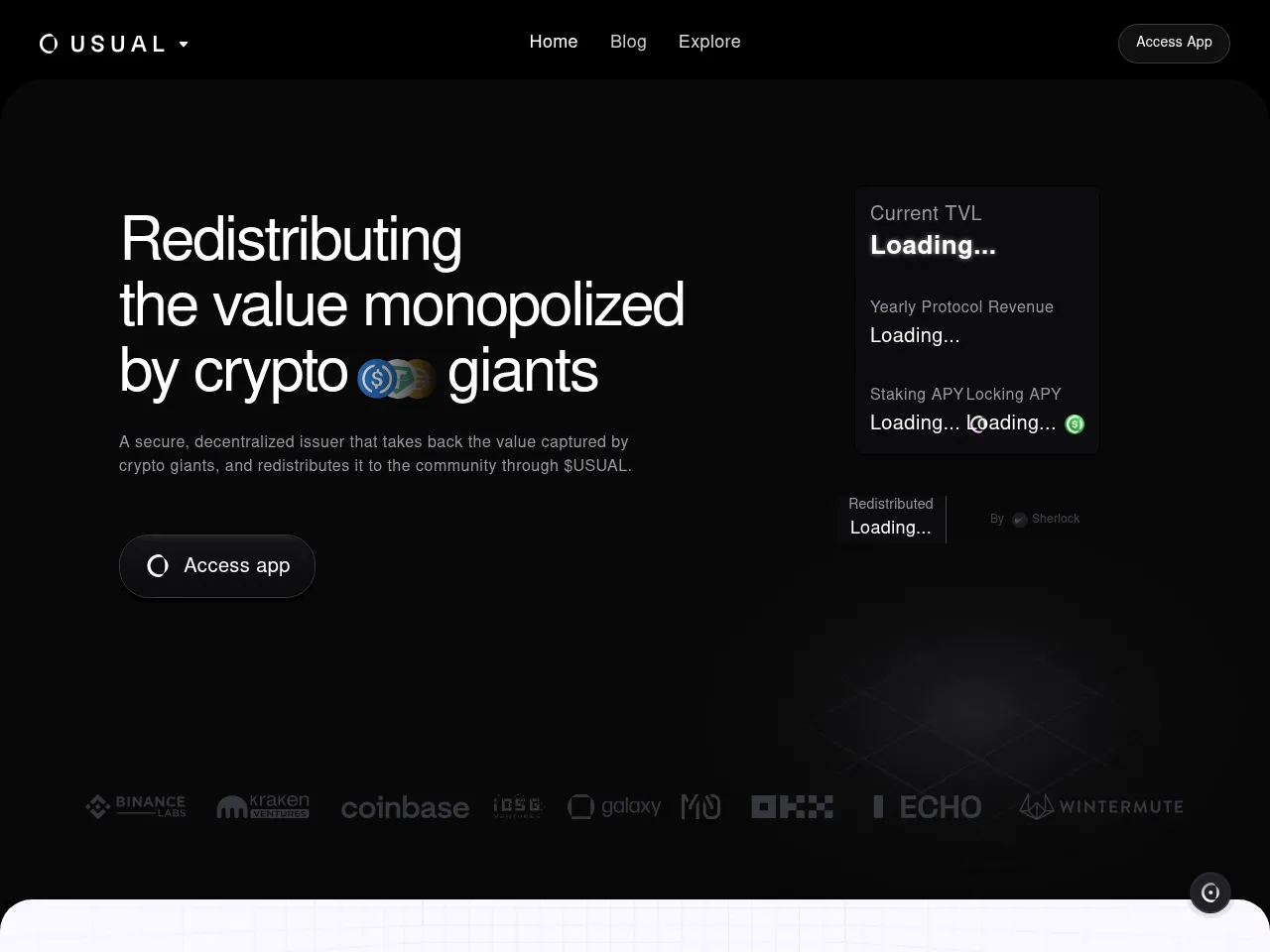
Usual is a decentralized stablecoin protocol that issues USD0, a stablecoin fully backed by real-world assets including U.S. Treasury bills and other short-term government securities. The protocol redistributes yield generated by its reserves to token holders and governance participants through the USUAL token, creating a community-owned stablecoin infrastructure. USD0++ is a staking derivative that locks USD0 for enhanced yields. Unlike centralized stablecoin issuers that retain all yield, Usual's model shares revenue with its community through tokenized governance rights. The protocol operates on Ethereum and has attracted significant TVL since its launch.
DeFi
Usual is a DeFi protocol that combines stablecoin issuance with yield redistribution and governance, offering USD0 and USD0++ as composable primitives across Ethereum DeFi.
Ethereum dApps
Usual operates on Ethereum, providing a decentralized stablecoin backed by real-world assets with community-owned governance and yield distribution.
Stablecoins
Usual issues USD0, a decentralized stablecoin backed by U.S. Treasury bills that redistributes yield to the community through the USUAL governance token.
Usual is a decentralized stablecoin protocol built on Ethereum that aims to redistribute value and ownership back to users through its governance token USUAL. The project's core offering centers around USD0, a stablecoin backed by real-world assets (RWAs), positioning itself at the intersection of DeFi and traditional finance. The protocol's approach of backing its stablecoin with tokenized treasuries and other RWAs rather than purely algorithmic mechanisms adds a layer of transparency and collateral security. The redistribution model, where protocol revenue and governance power flow to token holders, is an appealing value proposition in the stablecoin space dominated by centralized issuers like Tether and Circle. However, the project faces significant challenges: the stablecoin market is fiercely competitive, regulatory scrutiny around stablecoins is intensifying globally, and RWA-backed models introduce counterparty and custodial risks. As a relatively newer entrant, Usual still needs to prove sustained adoption and liquidity depth. The concept is sound, but execution and scaling remain key risks investors should monitor closely.
Category Ratings
DeFi
3.7
Ethereum dApps
3.5
Stablecoins
3.6
Feb 15, 2026
AI-Generated Review
Generated via Anthropic API.
This is an automated evaluation, not a consumer review.
Learn more
System Prompt Used:
You are Claude Opus 4.6, an AI crypto analyst for Dicryptory.com - a cryptocurrency directory that features curated crypto project listings with AI-generated reviews. Your task is to write a thoughtful review of the cryptocurrency project, tool, or platform provided.
Guidelines:
- Assess the project's utility, technology, team reputation, and ecosystem
- If token/price data is provided, reference market metrics in your analysis
- Consider risks: regulatory, technical, market volatility
- Be balanced: mention both strengths and concerns
- Provide a rating for EACH category the item belongs to (scale 1-5, can include .1 increments like 3.1, 4.8)
- Consider the item's performance/fit within each specific category when giving ratings
- Keep the review between 80-200 words
- Write in a professional, analytical tone suitable for crypto enthusiasts
User Prompt: Please review the following:
Name: Usual
Website: https://usual.money
Categories: DeFi, Ethereum dApps, Stablecoins
Token Data:
- Symbol: USUAL
- Blockchain: Ethereum