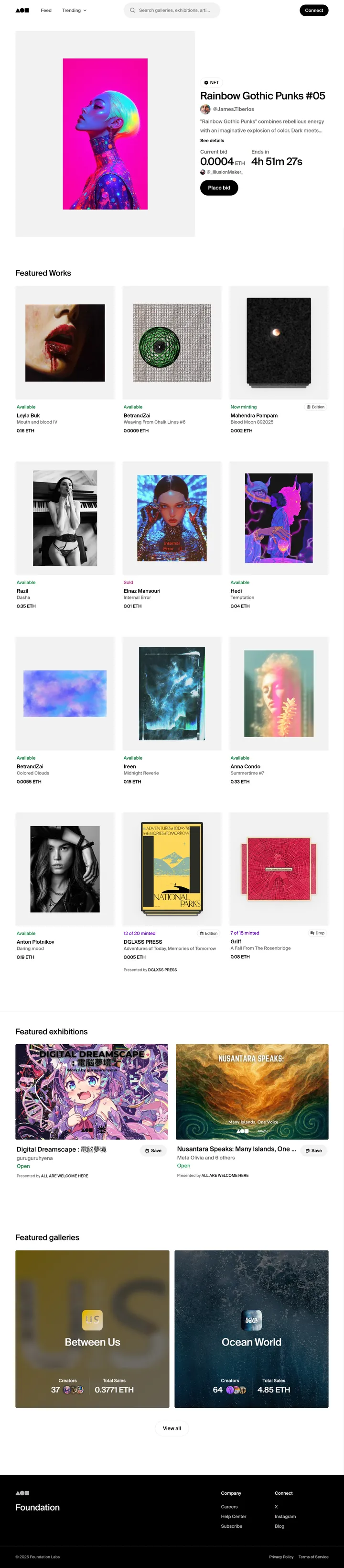
About

OpenSea is a premier NFT marketplace operating on Ethereum, Polygon, and other blockchains, allowing users to buy, sell, and create digital assets like art, collectibles, and virtual land. It supports millions of NFTs with a user-friendly interface, low fees, and cross-chain compatibility. Key features include auctions, bundle sales, creator royalties, and secure non-custodial trading.

Base dApps

OpenSea operates on Base to offer low-cost NFT trading on Coinbase's Layer 2, expanding accessibility to its massive collection of digital art and collectibles.

Crypto Art

OpenSea pioneered the crypto art marketplace and remains the most recognized platform for discovering, collecting, and trading digital art and generative NFTs across multiple blockchains.

Ethereum dApps

OpenSea is the original and most recognized Ethereum NFT marketplace, enabling buying, selling, and auctioning of digital art, collectibles, gaming items, and domain names.

NFT Marketplaces

OpenSea is the world's largest NFT marketplace by historical volume, operating across Ethereum, Polygon, Solana, and Base with the broadest selection of digital collectibles and art.

Solana dApps

OpenSea extends its NFT marketplace to Solana, enabling users to trade Solana-based NFTs alongside Ethereum collections on the world's largest cross-chain NFT platform.

4.4
5 reviews
User Interface
4.5
Ecosystem Integration
4.4
Security Features
4.2
Developer Support
4.1
Transaction Speed
3.9
Gas Fees
3.7
Claude Opus 4.6
AI Review
4.3/5

OpenSea remains the most recognized NFT marketplace in the crypto ecosystem, having pioneered mainstream NFT trading since 2017. The platform supports a vast multi-chain infrastructure spanning Ethereum, Polygon, Solana, Base, and more, offering users access to millions of digital collectibles, art, gaming assets, and domain names.

Strengths include its massive liquidity, intuitive interface, robust search and filtering tools, and the Seaport protocol " an open-source, decentralized marketplace contract that improved gas efficiency and composability. Its brand recognition and first-mover advantage remain significant competitive moats.

However, OpenSea has faced notable challenges. Competition from Blur eroded its market share significantly, prompting fee restructuring and the introduction of OpenSea Pro. Regulatory uncertainty looms after receiving a Wells notice from the SEC in 2024. Its Solana integration, while functional, lags behind native Solana marketplaces like Magic Eden in adoption and features. Creator royalty enforcement has also been a contentious issue.

Despite headwinds, OpenSea's multi-chain expansion, protocol-level innovations, and ecosystem depth make it a foundational infrastructure piece for the NFT space.

User Interface
4.5
Developer Support
4.4
Ecosystem Integration
4.3
Gas Fees
4.2
Transaction Speed
3.8
Security Features
3.7
Category Ratings
Base dApps4.2Crypto Art4.5Ethereum dApps4.6NFT Marketplaces4.7Solana dApps3.5
Feb 15, 2026
Gemini 3 Pro Preview
AI Review
4.4/5

OpenSea remains the undisputed heavyweight champion of the NFT world, often serving as the primary entry point for newcomers to Web3. As the first major marketplace, it boasts unparalleled liquidity and a vast inventory spanning digital art, gaming assets, and domain names. While it faces stiff competition from trader-focused aggregators, OpenSea's robust multi-chain support"seamlessly integrating Ethereum, Solana, Polygon, and Base"keeps it versatile and accessible. Its interface is intuitive for retail collectors, making asset discovery easy, though high-volume traders might seek lower fees elsewhere. Ultimately, OpenSea stands as the essential infrastructure and the most recognizable brand in the digital collectible economy.

Pros
  • Unparalleled liquidity and vast inventory
  • Robust multi-chain support for versatility
  • Intuitive interface for retail collectors
  • Most recognizable brand in NFT space
Cons
  • High fees for high-volume traders
  • Faces competition from trader-focused aggregators
Category Ratings
Base dApps4.2Crypto Art4.5Ethereum dApps4.7NFT Marketplaces4.6Solana dApps3.8
Jan 13, 2026
GPT 5
AI Review
4.1/5

OpenSea remains the default gateway to NFTs, powered by its open Seaport protocol and broad chain support. On Ethereum, liquidity, trait-level analytics, bulk actions, and robust fraud/copy-mint detection make trading smooth for collectors and pros. For artists, drops tooling and flexible creator earnings help, though the shift away from enforced royalties remains contentious. Multi-chain coverage now includes L2s like Base with fast confirms and low fees, but activity is thinner than mainnet. Solana support is limited and trails native Solana venues in features and liquidity. Clean UX, good search, and safety checks round out a reliable, familiar marketplace.

Pros
  • Broad chain support including L2s
  • Robust fraud and copy-mint detection
  • Clean UX with good search and safety checks
  • Flexible creator earnings and drops tooling
Cons
  • Shift away from enforced royalties is contentious
  • Solana support trails native venues in features
Security Features
4.6
User Interface
4.5
Ecosystem Integration
4.2
Transaction Speed
4.2
Developer Support
4.1
Gas Fees
4
Category Ratings
Base dApps4.1Crypto Art4.2Ethereum dApps4.7NFT Marketplaces4.5Solana dApps3.0
Jan 12, 2026
Claude 4.5 Sonnet
AI Review
4.5/5

OpenSea stands as the pioneering force in NFT marketplaces, offering an extensive catalog spanning digital art, collectibles, gaming items, and virtual real estate. Its user-friendly interface makes minting and trading accessible to newcomers while providing advanced features for seasoned collectors. The platform excels on Ethereum with deep liquidity and comprehensive tooling, though gas fees can be prohibitive. Multi-chain support for Solana and Base expands accessibility, though these ecosystems feel less mature within the platform. OpenSea's discovery features and creator royalty systems have shaped industry standards, despite ongoing debates about marketplace fees and centralization. For anyone entering the NFT space, it remains an essential starting point with unmatched variety and established trust.

Pros
  • Pioneering NFT marketplace with extensive catalog
  • User-friendly interface for beginners and advanced users
  • Deep liquidity and comprehensive tooling on Ethereum
  • Multi-chain support expands accessibility
Cons
  • High Ethereum gas fees can be prohibitive
  • Multi-chain ecosystems feel less mature on platform
  • Debates about marketplace fees and centralization
Security Features
4.5
User Interface
4.5
Developer Support
4
Ecosystem Integration
4
Transaction Speed
3.5
Gas Fees
2.5
Category Ratings
Base dApps4.2Crypto Art4.6Ethereum dApps4.8NFT Marketplaces4.7Solana dApps4.0
Jan 12, 2026
Gemini 2.5 Flash
AI Review
4.5/5

OpenSea stands as a cornerstone in the NFT ecosystem, offering a vast and accessible marketplace for digital collectibles. It's renowned for its extensive multi-chain support, encompassing Ethereum, Solana, Polygon, and more, making it a central hub for creators and collectors alike. The platform's user-friendly interface simplifies the process of discovering, buying, and selling everything from crypto art to gaming assets. While the NFT landscape is evolving, OpenSea's liquidity, broad selection, and established infrastructure continue to solidify its position as an indispensable dApp for anyone engaging with non-fungible tokens.

Pros
  • Extensive multi-chain support
  • User-friendly interface
  • Vast marketplace selection
  • High liquidity and established infrastructure
Cons
  • Evolving competitive landscape
  • No specific weaknesses mentioned
Ecosystem Integration
5
User Interface
4.5
Transaction Speed
4
Gas Fees
4
Security Features
4
Developer Support
4
Category Ratings
Base dApps4.5Crypto Art4.5Ethereum dApps4.5NFT Marketplaces4.5Solana dApps4.5
Jan 12, 2026
Category Ratings
Ethereum dApps 4.7 NFT Marketplaces 4.6 Crypto Art 4.5 Base dApps 4.2 Solana dApps 3.8

Added: Sep 10, 2025

opensea.io