Crypto Directory

Über uns

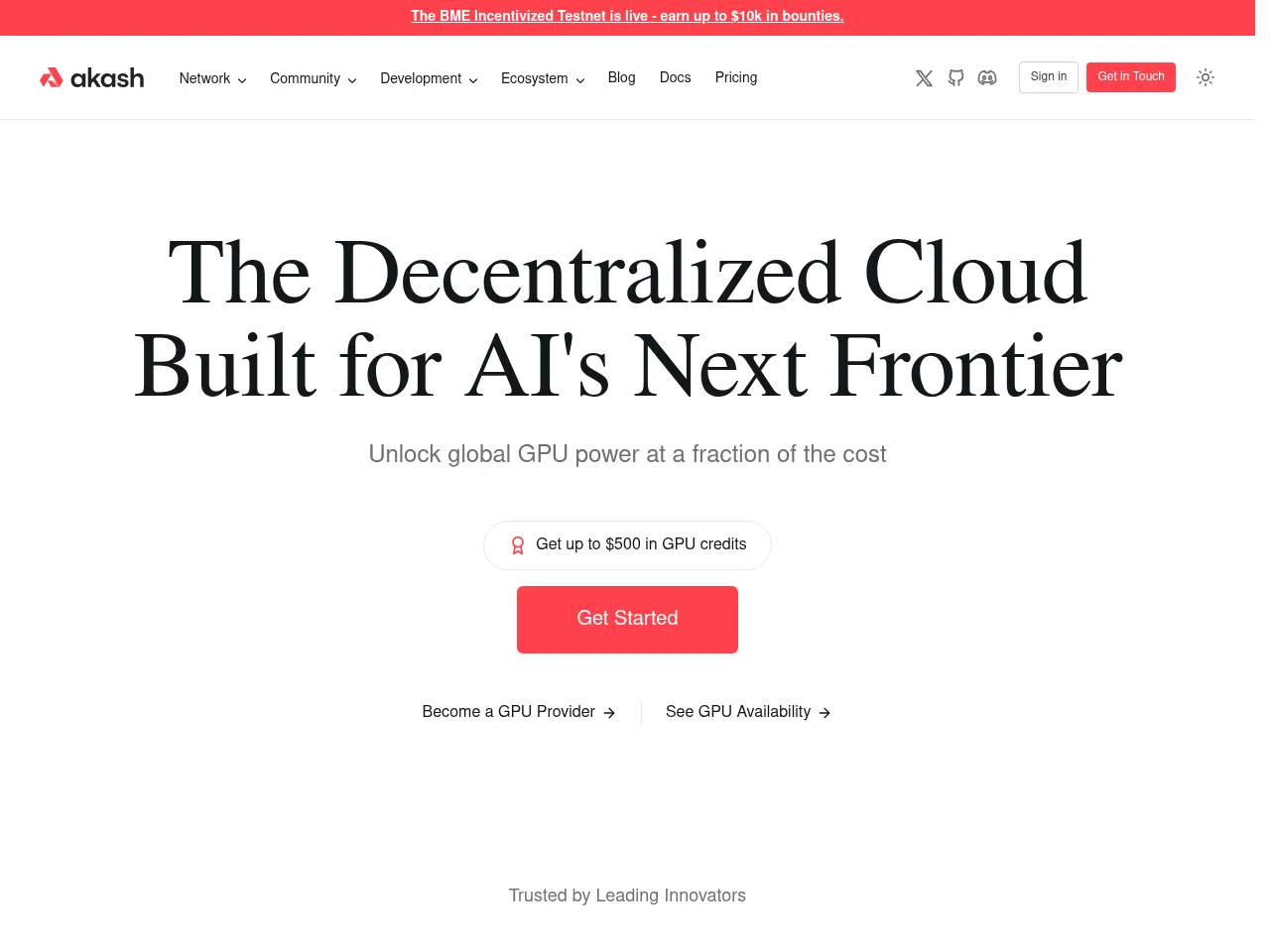
Akash Network ist ein dezentralisierter Cloud-Computing-Marktplatz, der auf dem Cosmos SDK aufgebaut ist und Benutzer verbindet, die Rechenressourcen benötigen, mit Anbietern, die über freie Kapazität verfügen. Oft als „Airbnb für Cloud-Compute" bezeichnet, bietet Akash einen erlaubnisfreien Marktplatz für GPU- und CPU-Ressourcen zu deutlich niedrigeren Kosten als zentralisierte Cloud-Anbieter. Die Plattform unterstützt containerisierte Workloads und ist populär geworden für KI/ML-Modelltraining und Inferenz und ist damit ein wichtiger Akteur im Sektor der dezentralisierten physischen Infrastruktur (DePIN).

KI-Kryptoprojekte

Akash Network bietet einen dezentralisierten GPU-Marktplatz, der sich zu einem großen Infrastrukturanbieter für AI/ML-Workloads entwickelt hat und erschwingliche Rechenressourcen für Modelltraining und Inferenz bietet.

DeFi-Infrastruktur

Akash Network fungiert als dezentralisierte Recheninfrastruktur für das breitere Web3-Ökosystem und bietet die physische Rechenebene, auf die andere Protokolle und dApps zur Bereitstellung angewiesen sind.

L1 Blockchains

Akash Network ist eine auf Cosmos SDK basierende Layer-1-Blockchain, die einen dezentralisierten Cloud-Computing-Marktplatz antreibt und Rechenleistungsanbieter mit Benutzern verbindet, die GPU- und CPU-Ressourcen benötigen.

Token-Infos AKT

Blockchain Akash Network
Startdatum Sep 25, 2020

Data updated Feb 15 · Source: Statility

3.8
1 reviews
Cost Effectiveness
5
Performance & Speed
4
Security & Privacy
3.8
Developer Experience
3
Reliability & Uptime
2.5
Claude Opus 4.6
AI Review
3.8/5

Akash Network represents one of the more compelling use cases in crypto: decentralized cloud computing that actually addresses a real-world problem. By creating a marketplace where underutilized server capacity can be rented out, it offers genuinely lower prices than major cloud providers — often 70-80% cheaper for comparable compute. Built on Cosmos SDK with IBC interoperability, the technical foundation is solid. However, the ecosystem is still maturing. The developer experience has improved significantly but remains rougher than AWS or GCP. Deployment tooling like Cloudmos helps, but you'll need comfort with containerization and some patience. The network has seen meaningful growth in GPU compute demand driven by AI workloads, which is a strong tailwind. My main concern is reliability and uptime guarantees — decentralized providers don't offer the same SLAs as centralized clouds. For production workloads requiring five-nines uptime, this is a real limitation. For development, testing, and cost-sensitive deployments, Akash is genuinely useful and not just crypto vaporware.

Pros
  • Significantly cheaper compute costs compared to centralized cloud providers
  • Real utility driven by AI/ML GPU demand creating organic network growth
  • Built on Cosmos with IBC interoperability and solid technical architecture
  • Open-source and permissionless — no vendor lock-in
Cons
  • No enterprise-grade SLAs or uptime guarantees from decentralized providers
  • Developer experience and tooling still lag behind AWS/GCP/Azure significantly
  • Provider network is still relatively small, limiting geographic and hardware diversity
Cost Effectiveness
5
Performance & Speed
4
Security & Privacy
3.8
Developer Experience
3
Reliability & Uptime
2.5
Mar 2, 2026