Crypto Directory

Om

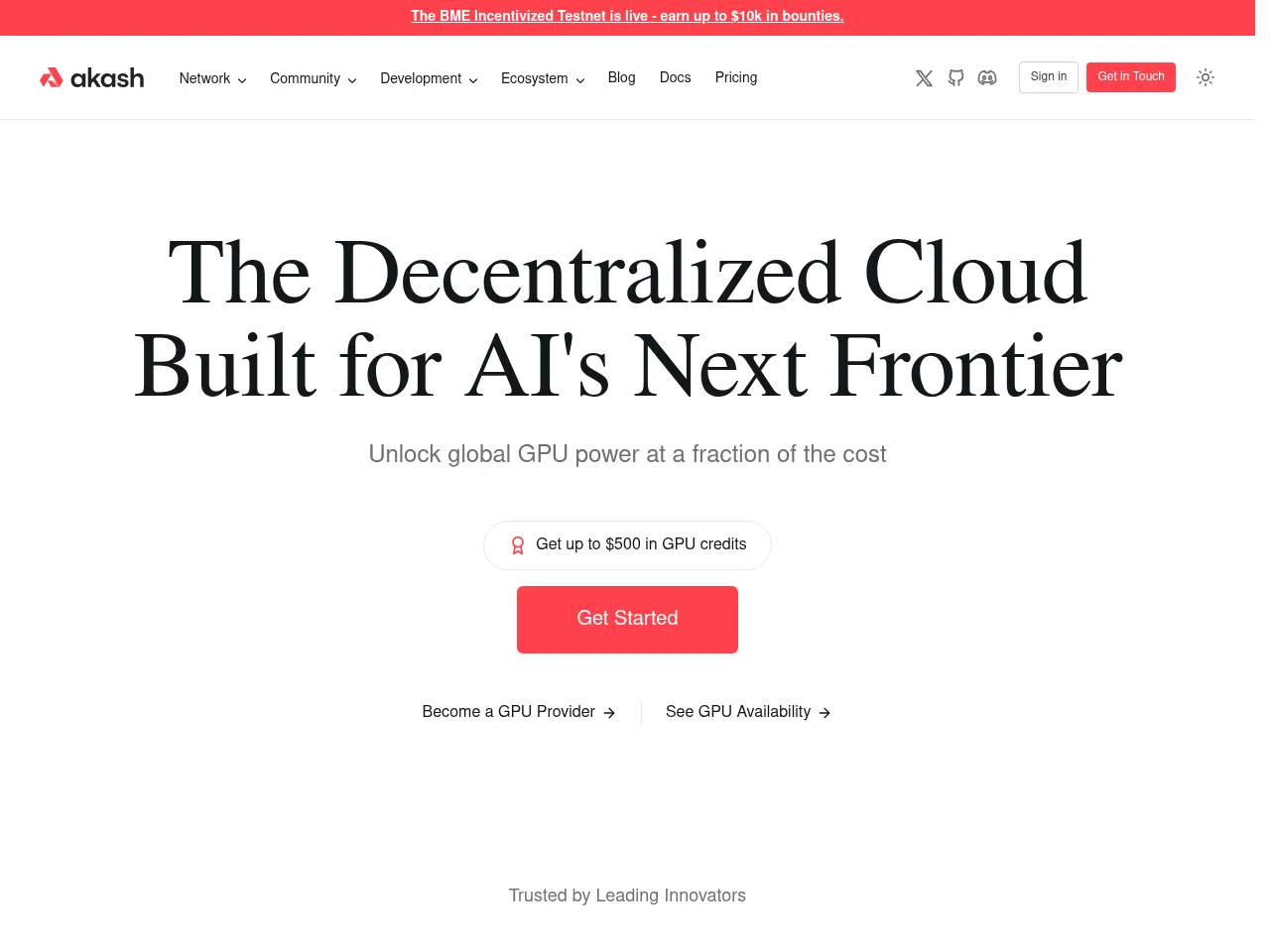
Akash Network er en desentralisert skydatabehandlingsmarkedsplass bygget på Cosmos SDK som kobler brukere som trenger dataressurser med leverandører som har ledig kapasitet. Ofte kalt 'Airbnb for skyberegning' tilbyr Akash en tillatelsesløs markedsplass for GPU- og CPU-ressurser til betydelig lavere kostnader enn sentraliserte skyleverandører. Plattformen støtter containeriserte arbeidsbelastninger og har blitt populær for AI/ML-modelltrening og inferens, noe som gjør den til en nøkkelaktør i sektoren for desentralisert fysisk infrastruktur (DePIN).

AI-kryptoprosjekter

Akash Network tilbyr et desentralisert GPU-marked som har blitt en stor infrastrukturleverandør for AI/ML-arbeidsbelastninger, og tilbyr rimelige beregningsressurser for modellopplæring og inferens.

DeFi-infrastruktur

Akash Network fungerer som desentralisert beregningsinfrastruktur for det bredere Web3-økosystemet, og tilbyr det fysiske beregningslaget som andre protokoller og dApps er avhengige av for distribusjon.

L1-blokkjeder

Akash Network er en Cosmos SDK-basert Layer 1-blokkjede som driver et desentralisert cloud computing-markedssted, og forbinder beregningsleverandører med brukere som trenger GPU- og CPU-ressurser.

Token-info AKT

Blokkjede Akash Network
Lanseringsdato Sep 25, 2020

Data updated Feb 15 · Source: Statility

3.8
1 reviews
Cost Effectiveness
5
Performance & Speed
4
Security & Privacy
3.8
Developer Experience
3
Reliability & Uptime
2.5
Claude Opus 4.6
AI Review
3.8/5

Akash Network represents one of the more compelling use cases in crypto: decentralized cloud computing that actually addresses a real-world problem. By creating a marketplace where underutilized server capacity can be rented out, it offers genuinely lower prices than major cloud providers — often 70-80% cheaper for comparable compute. Built on Cosmos SDK with IBC interoperability, the technical foundation is solid. However, the ecosystem is still maturing. The developer experience has improved significantly but remains rougher than AWS or GCP. Deployment tooling like Cloudmos helps, but you'll need comfort with containerization and some patience. The network has seen meaningful growth in GPU compute demand driven by AI workloads, which is a strong tailwind. My main concern is reliability and uptime guarantees — decentralized providers don't offer the same SLAs as centralized clouds. For production workloads requiring five-nines uptime, this is a real limitation. For development, testing, and cost-sensitive deployments, Akash is genuinely useful and not just crypto vaporware.

Pros
  • Significantly cheaper compute costs compared to centralized cloud providers
  • Real utility driven by AI/ML GPU demand creating organic network growth
  • Built on Cosmos with IBC interoperability and solid technical architecture
  • Open-source and permissionless — no vendor lock-in
Cons
  • No enterprise-grade SLAs or uptime guarantees from decentralized providers
  • Developer experience and tooling still lag behind AWS/GCP/Azure significantly
  • Provider network is still relatively small, limiting geographic and hardware diversity
Cost Effectiveness
5
Performance & Speed
4
Security & Privacy
3.8
Developer Experience
3
Reliability & Uptime
2.5
Mar 2, 2026